How to raise prices without losing profit: the break-even customer loss
A 10% price rise on a 40% margin can lose 20% of customers and still earn the same. The break-even formula, a worked example, and how to roll it out in January.
Most small businesses raise prices too late and too little, for the same reason: the fear of losing customers. The fear is reasonable. The arithmetic is usually not done. And the arithmetic says that a business can lose a surprising share of its customers after a price rise and still make more money — how many depends on one thing, the margin.
The formula
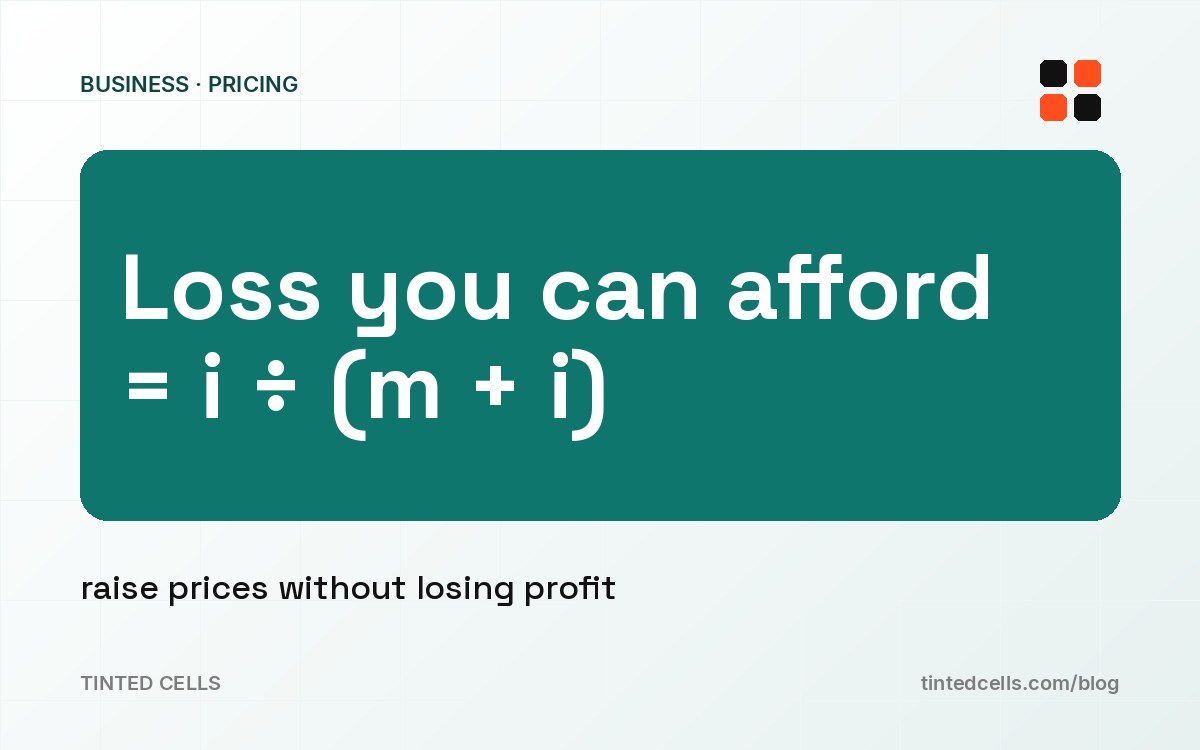
Take a price increase i (10% = 0.10) and your contribution margin m — price minus the variable costs of one sale, as a share of the price. The share of customers you can lose and still earn exactly what you earn today is:
Break-even customer loss = i ÷ (m + i)
A few values for a 10% increase:
| Contribution margin | Customers you can lose |
|---|---|
| 20% | 33% |
| 40% | 20% |
| 60% | 14% |
| 80% | 11% |
The lower your margin, the more a price rise is worth — because every extra dollar of price is pure margin, and a thin-margin business was earning very few dollars per sale before.
A worked example
A service business sells 200 sessions a month at $50. The variable cost of a session — materials, card fees, the freelancer’s share — is $30. Contribution: $20 per session, $4,000 a month, a 40% margin.
Raise the price 10% to $55. Contribution becomes $25 per session. To earn the same $4,000 you need 4,000 ÷ 25 = 160 sessions — you can lose 40 customers, 20%, and be exactly where you started.
In practice, a considered 10% rise rarely loses anything close to that. If 8% of customers leave, you sell 184 sessions × $25 = $4,600: 15% more profit for the same work — fewer sessions, in fact.
What moves the real loss
Whether you lose 3% or 25% of customers after a price rise depends much less on the percentage than on how it is done:
- Notice. Four to six weeks’ warning, with a date, reads as professional. A new price on the next invoice reads as a surprise.
- A reason in one sentence. Costs rose, the product got better, or the old price was an introductory one. No long apology.
- Existing customers first, or last. Either give loyal customers the new price later (“your price is unchanged until April”) or first, with the notice — but decide on purpose.
- Round, confident numbers. $55 is easier to accept than $54.37.
- January is the best month. Customers expect new prices at the start of the year, and your costs for the year are clearest then.
The check before you do it
Run three numbers before you announce anything:
- Break-even loss at the increase you plan (the formula above).
- Your realistic loss — what share of customers is truly price-sensitive? For most businesses it is the ones already asking for discounts.
- The profit change at the realistic loss. If it is positive with room to spare, the question is no longer “should I” but “how much”.
Then compare two or three sizes. A 5% rise with almost no loss and a 12% rise with a small loss often end in very different places — and the larger one is frequently the better one.
After the change, count. Customers lost over the next two or three months, compared with the break-even number, tell you whether you have room for the next rise — and most businesses discover they had more room than they feared.
The Price Increase Simulator does this in a few minutes: your prices, variable costs and customer counts in, then the break-even loss for any increase, the profit change at the loss you expect, a side-by-side of three rise sizes, and a verdict — raise, raise less, or wait.