Black Friday for small online shops: 6 numbers to know before the sale
Before Black Friday, know six numbers: profit per order, max discount, break-even ROAS at the discount, cash in stock, lowest cash to January and your real payout rate.
Every year the same thing happens in small shops. Black Friday is the best revenue week of the year, the dashboard is green, and in the second week of January the bank balance is lower than it was in October. Nothing went wrong on the day. The damage was done in the weeks before — in decisions made without six numbers that take an evening to work out.
Here they are, in the order they matter, with one product worked through all six: a $40 product that costs $14 to make or buy, $5 to ship, and loses 9.5% plus $0.30 to platform and payment fees.
1. Profit per order at full price
Price − cost − shipping − fees. For the example: 40 × (1 − 0.095) − 14 − 5 − 0.30 = $16.90.
This is contribution — what one order adds before ads and fixed costs. Most sellers can quote their revenue to the dollar and have never written this number down per product. It is the base for everything below, so it has to be right: use your real shipping, including packaging, and the fee rate you actually paid last month, not the headline rate.
2. The maximum discount before an order loses money
Fees are charged on the discounted price, so the break-even discount is:
Max discount = 1 − (cost + shipping + fixed fees) ÷ (price × (1 − fee %))
For the example: 1 − 19.30 ÷ 36.20 = 46.7%. Anything deeper and every order is a loss, however many you sell. Anything close to it is almost as bad, because of number three.
Run this for every product in the sale. Some will tolerate 40% off; the low-price, heavy-to-ship ones often break even at 15%. Those should sit out the sale or get a gift instead of a discount.
3. How many more orders the discount needs
At 25% off the example earns 30 × 0.905 − 19.30 = $7.85 per order. To make the same money as at full price you need 16.90 ÷ 7.85 = 2.2× the orders.
That is the honest cost of a discount, and it is rarely what sellers assume. A 25% sale that brings 60% more orders — a good result by most standards — leaves you with less profit than doing nothing. Our Black Friday discount calculator does this for one product in a minute; do it before you choose the percentage, not after.
4. Break-even ROAS at the sale price
If you advertise during the sale, the ROAS your ads need to break even rises with the discount:
Break-even ROAS = sale price ÷ profit per order at the sale price
At full price: 40 ÷ 16.90 = 2.37. At 25% off: 30 ÷ 7.85 = 3.82. A campaign that was comfortably profitable at a ROAS of 3 in October loses money on every sale in the Black Friday week — and the ad platform will report it as a success. Set the new floor per product before the week starts and cut anything below it on day one, not in the December review.
5. Cash sitting in stock, and the lowest balance to January
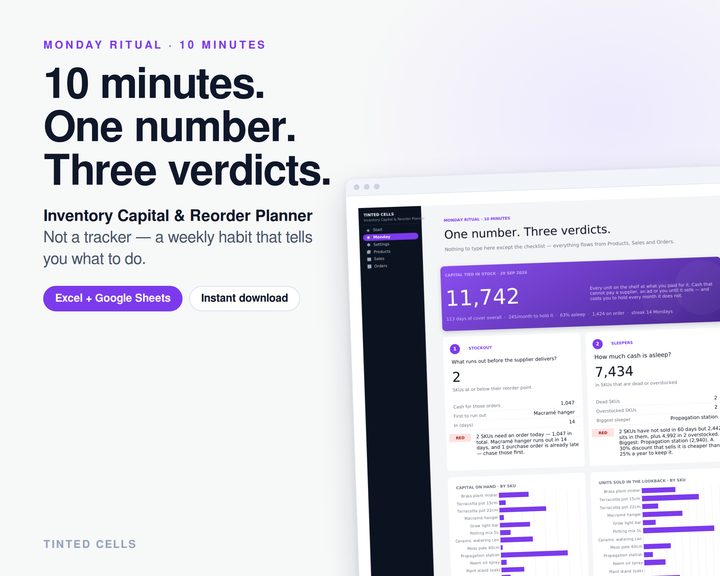
Stock bought for the peak is cash you cannot spend until it sells. Add it up at cost: units on hand × landed cost, per product. Then look at which products have not moved in 60–90 days. Those — not your bestsellers — are what the sale should clear.
The second half of this number is time. November stock orders, December ad spend and a quiet January land on the same bank account. A 13-week forecast — money in and out per week — shows the lowest point before it arrives. If it dips below a month of fixed costs, change the order size now, while the supplier still takes changes.
6. Your real payout rate
After the peak, compare what the marketplace paid out with what the orders said you sold. Refunds, return shipping, chargebacks, offsite-ad fees and currency conversion all come off in between. On Etsy and Shopify a real take rate 3–6 points worse than expected is common in December. You will want that number before you plan January’s prices — which is the natural next step: a small price increase in January usually recovers more margin than the sale gave away.
The one-evening version
Six numbers, one evening, done in October or early November:
- profit per order at full price, every product;
- max discount per product — and which products sit out;
- orders needed at your planned discount;
- break-even ROAS at the sale price, per product;
- cash in stock and the lowest balance through January;
- a payout check booked for the first week of December.
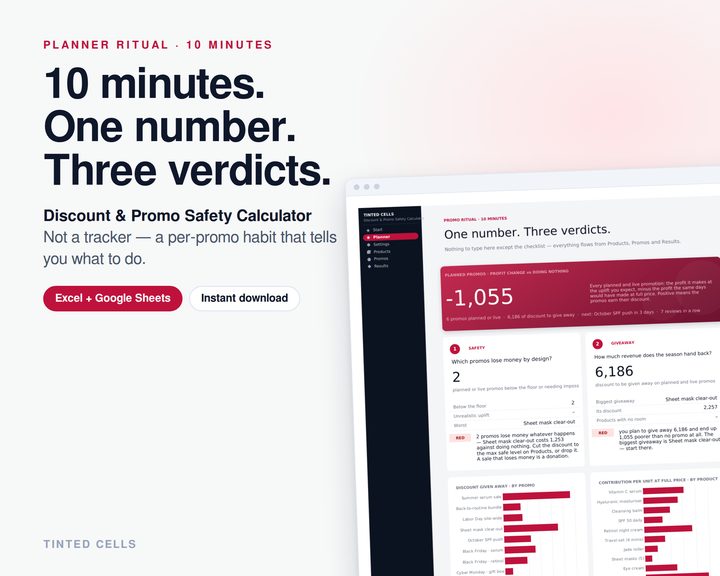
The Profit Ritual — E-commerce Profitability Model does numbers one to four for the whole catalogue: contribution and break-even ROAS per SKU, SCALE / HOLD / CUT per campaign, margin per order, and the Scenarios sheet for discount levels. The rest of the list is in the Q4 Seller Pack — the promo safety check, the inventory capital planner, the 13-week cash flow and the payout decoders — built for exactly this quarter.