Paying off Christmas: a 90-day plan for holiday credit card debt
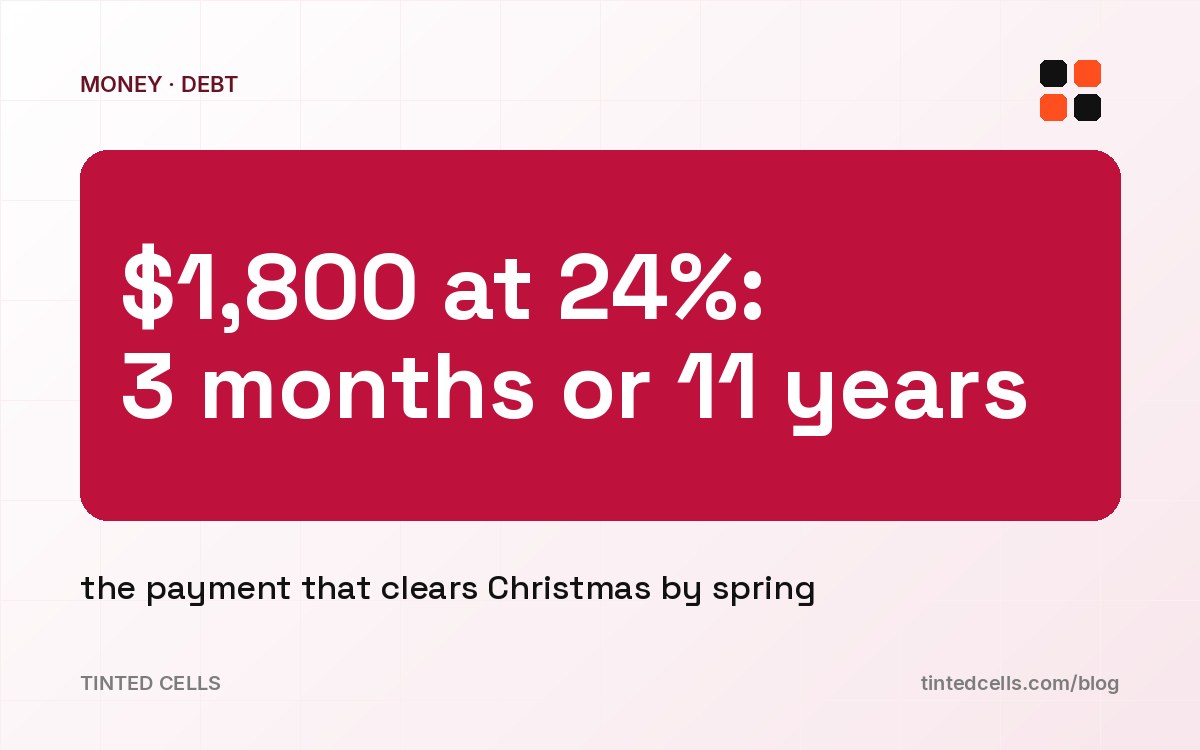
$1,800 of holiday spending on a card at 24% APR: 11 years and $2,487 of interest on minimum payments, or 3 months and $72. How to set the payment and find it.
January statements are where holiday spending becomes real. For a lot of households it arrives as a single number on a credit card — and the way that number gets paid decides whether Christmas cost what it cost, or twice as much.
Take a typical case: $1,800 on a card at 24% APR, which is 2% interest a month.
What the minimum payment really costs
Most cards ask for about 3% of the balance each month, with a floor of around $25. On $1,800 that is $54 in January, which feels manageable. It is designed to.
Paying only the minimum, the balance takes 133 months — just over eleven years — to clear, and costs $2,487 in interest. More than the Christmas itself. Every month, most of the payment goes to interest, and as the balance falls the minimum falls with it, so the end keeps moving away.
Pick the date first, then the payment
The useful question is not “what can I pay” but “when do I want this gone”. Once you choose a date, the monthly payment is a formula:
Payment = balance × r ÷ (1 − (1 + r)^−months)
where r is the monthly interest rate (APR ÷ 12). For $1,800 at 2% a month:
| Clear it in | Monthly payment | Total interest |
|---|---|---|
| 3 months (end of March) | $624 | $72 |
| 6 months (end of June) | $321 | $128 |
| Minimum payments only | $54, falling | $2,487 |
Three months is the target worth aiming for: the holiday is paid before spring, and the interest is a rounding error. If $624 a month is out of reach, six months at $321 is still a completely different outcome from the minimum.
Where the payment comes from
A plan that needs $624 a month needs to say where it comes from. In most households it is a combination of four things:
- The holiday savings line stops. Whatever you set aside in autumn for Christmas has nothing left to fund — redirect exactly that amount to the card.
- One or two variable categories go on a strict cap for 90 days. Eating out and “shopping” are the usual candidates. A cap that ends on a date is much easier to keep than a vague “spend less”.
- Anything unwanted gets sold or returned. January returns windows are still open for many gifts; duplicates and unused items sell well in the first weeks of the year.
- Any windfall goes to the card — a tax refund, a January bonus, money gifts.
If you have more than one balance
With two or more cards, the order matters. Pay the minimum on everything and put every extra dollar on one card at a time. The avalanche order — highest interest rate first — costs the least; the snowball order — smallest balance first — clears whole cards sooner, which keeps many people going. Either works far better than spreading the extra thinly across all of them. (We compared both with real numbers in snowball vs avalanche.)
A balance transfer to a 0% card can help if the transfer fee is small and you can clear the balance before the promotional rate ends. Treat it as a way to stop the interest while you pay, not as extra time.
Keeping the date real
A debt plan fails quietly: one month the payment is a bit lower, the next month a bit lower again, and by April the end date has slipped to autumn. Two habits stop that:
- Check the date, not the balance. Once a month, recompute when the debt will be gone at the current pace. If the date moves, you know that month, not in June.
- Stop adding to it. A card being paid off is not a card for new spending. Remove it from phone wallets and online shops until it is at zero.
The Debt Payoff Ritual is built around that one number: the debt-free date. List the balances, rates and minimums, choose snowball or avalanche, and once a month it shows the date, the interest you are saving, and three verdicts — which balance gets the extra payment, whether the pace is holding, and what to change if it is not.