How much can you discount before you lose money? The break-even uplift, explained
A 20% discount often needs 40–80% more units just to break even. Learn the max safe discount and break-even uplift formulas before Black Friday.
A 20% discount does not cost you 20%. It costs you 20% of the price but 100% of the margin that 20% represented — and on most products the margin is a lot thinner than the price. That is why a record-revenue sale week so often ends with a worse bank balance. The promo sold more units and each unit earned less, and nobody checked whether the first outweighed the second.
Two numbers tell you in advance.
Max safe discount
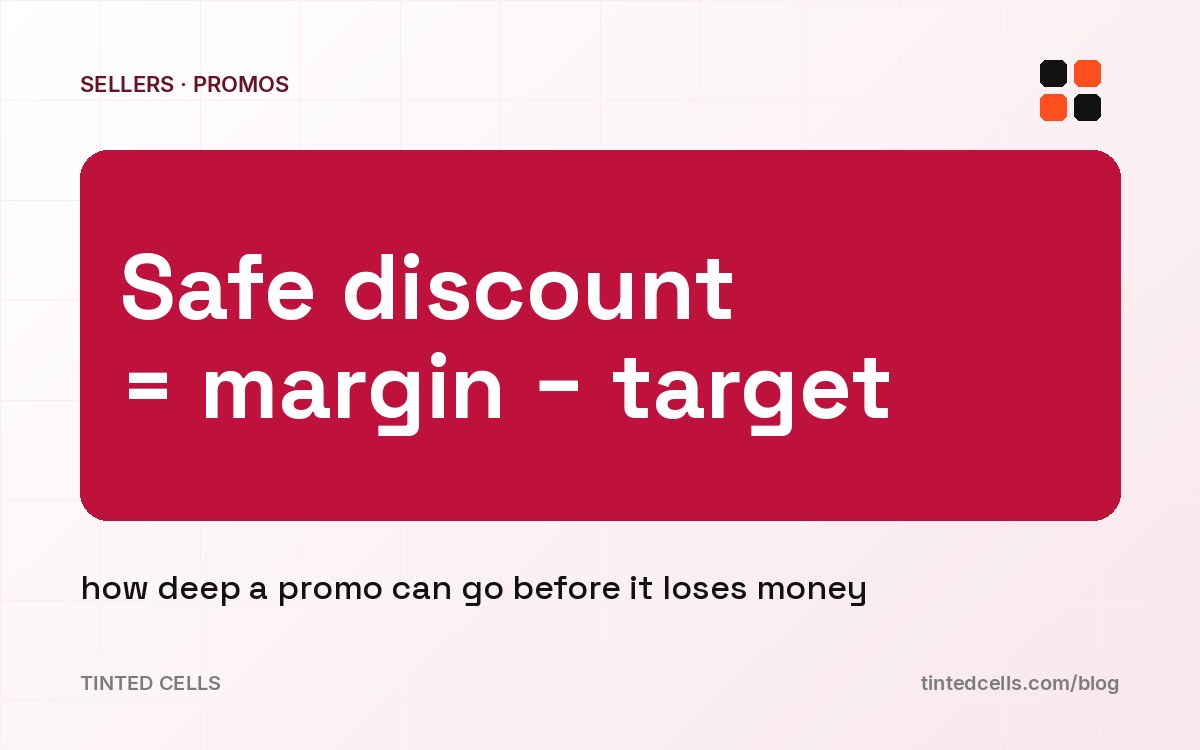
Decide the least a unit may leave after the discount — a margin floor. 20% of the discounted price is sane for a store that also pays for ads. Then:
Max safe discount = 1 − (COGS + shipping) ÷ (price × (1 − fees% − floor))
A $48 serum with $9.50 COGS, $4.20 shipping and 6% fees, at a 20% floor: 1 − 13.70 ÷ (48 × 0.74) = 1 − 0.386 = 61%. Deep discounts are possible on a high-margin product. A $19 sheet-mask pack with $7.90 COGS and $4.60 shipping: 1 − 12.50 ÷ (19 × 0.74) = 11%. That product should be left out of every sale — a 20% code on it sells units at a loss.
Break-even uplift
Even inside the safe range, a discount only pays if it sells enough extra units to earn what full price would have earned. The extra needed is:
Break-even uplift = (contribution at full price ÷ contribution at promo price) − 1
The serum earns $31.42 per unit at full price. At 20% off it earns $38.40 − 2.30 fees − 9.50 − 4.20 = $22.40. Uplift needed: 31.42 ÷ 22.40 − 1 = 40%. At 30% off it earns $17.90 and needs 76% more units. On the sheet masks, 20% off needs roughly 200% more units — three times the volume, which no email list delivers.
The table for your own catalogue takes ten minutes and is worth more than any promo calendar: for each product, the max safe discount and the uplift needed at 10, 20 and 30% off.
Judging a promo before it goes live
Put the two numbers together with two guesses — baseline units per day and the uplift you expect — and every planned promo gets a verdict:
LOSS if the discounted margin is under the floor. UNREALISTIC if the uplift needed is more than any promo you have run has delivered (150% is a generous ceiling). RISKY if the uplift needed is more than the uplift you expect. SAFE otherwise — with a number: profit with the promo minus profit without it, over the same days.
The last one is the point. A promo is not a success because it sold a lot; it is a success if it made more than doing nothing would have.
Keeping score
After the promo, type the units actually sold. Actual uplift = units sold ÷ baseline units for those days − 1. Compare with the uplift you expected. Two or three of these and you know your real number — most stores find it is closer to +40% than the +100% they assumed — and the next plan is calibrated instead of hopeful.
The Discount & Promo Safety Calculator runs this whole loop: a Products sheet with max safe discount and break-even uplift at three levels, a Promos sheet that gives every planned promotion SAFE / RISKY / UNREALISTIC / LOSS before it goes live, a Results sheet that scores each ended promo WON or LOST against doing nothing, and a Planner page with one number — planned profit change vs no promo — for the season.
List it in October. By the time Black Friday arrives, every discount should have a break-even next to it.