Vending machine profit per machine: the four costs that turn $400 of sales into $90
How to calculate net profit per vending machine: sales minus restock, location commission, card fees and the real cost of every service visit — plus payback and when to pull a machine.
The vending business is sold on one number — “each machine makes $300–500 a month” — and that number is sales. Nobody keeps sales. What a machine actually adds to the bank is sales minus four costs, and the fourth one is the one operators forget until the route stops growing.
The four costs
Restock. What the products in the machine cost you, typically 40–55% of sales for snacks and drinks. A $400 machine month is a $200 restock bill.
Location commission. The building takes a share, commonly 10–15% of sales, sometimes nothing for a small site. On $400 that is $40–60.
Card fees. Cashless readers charge a percentage of card sales plus a monthly fee. At 6% on $240 of card sales, another $14.
Visits. Every service visit costs fuel and time. If a visit is 40 minutes door to door and your time is worth $25 an hour, a visit costs about $22 before the fuel. A machine on a 14-day cycle takes two visits a month: $44. This is the cost that decides whether small machines are worth it — a $150-a-month machine visited every two weeks gives more than a quarter of its gross back to the drive.
Net for the $400 machine: 400 − 200 − 50 − 14 − 44 = $92. That is the number to rank machines by, and it is a fifth of the “$400” the listing promised.
Net per month, per machine, ranked
Once every visit is logged — cash collected, card sales since the last visit, restock cost — net per machine for the last 30 days falls out of the arithmetic. Rank the route by it and a pattern always appears: two or three machines carry the route, most are fine, and one or two cost as much to visit as they earn. A machine under about $120 net a month is worth a decision: renegotiate the commission, stretch the visit interval by a week, or move it to the next location on the list. A machine with negative net after visits is a machine you are paying to keep.
The visit interval is a lever most operators never touch. A slow machine visited every 21 days instead of 14 saves a third of its visit cost and rarely runs out. A fast machine visited every 7 days instead of 14 stops losing sales to empty slots. The interval should follow the machine’s velocity, not the calendar.
Payback: whether the next machine is justified
A $3,000 machine earning $150 net a month pays for itself in 20 months. At $300 net, 10 months. The route-level version — total machine cost divided by total net per month — is the number to check before buying another one. Under about 18 months, the next machine is a good idea; over 24, fix the low earners first, because that is free capital.
Two more numbers keep the route honest: days since each machine’s last visit against its interval (an empty machine earns nothing and loses the location), and the margin per slot on the products — vending lives on margin per unit, and anything under 50% is a slot that should hold something else.
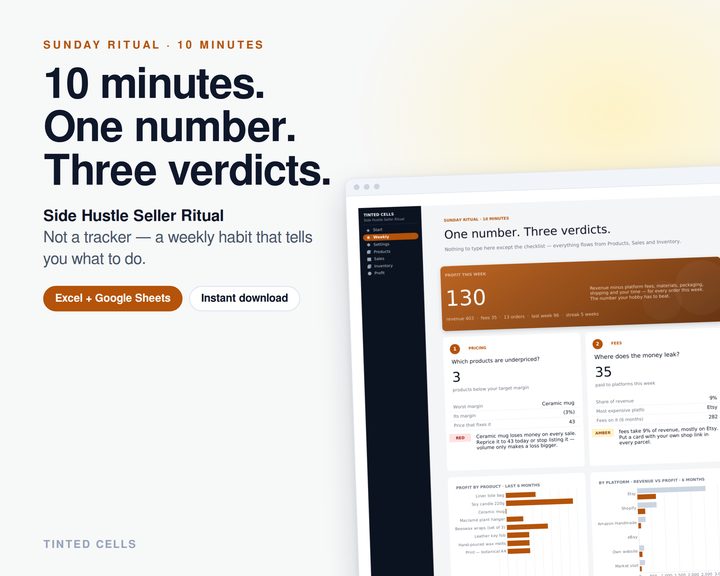
The Vending Machine Ritual spreadsheet runs the route by these numbers: one line per machine (location, cost, commission, interval), one line per visit (cash, card, restock), a product list with margin per slot, and a Monday page with net profit for the last 30 days across all machines and three verdicts — machines overdue for a visit, machines below the minimum net, and route payback against your alarm.
Whatever you use, stop quoting sales. Quote net per machine per month. It is the only number the bank sees.