How to set up a family budget spreadsheet you will still open in March
Most family budget spreadsheets die by February. Set one up around a single number, a ten-minute weekly check and categories that match real life — step by step.
Almost every family budget spreadsheet starts the same way: a long evening in January, forty categories, colour coding, a pie chart. By the end of February nobody has opened it for three weeks, the receipts are piling up and the file quietly becomes another thing to feel guilty about.
The spreadsheet was not the problem. The design was. A budget that the whole household actually uses has to answer one question quickly — how much can we still spend this month? — and it has to take less time each week than the arguments it prevents. Here is how to build one around that idea.
Step 1: start from take-home pay, not from a template
Write down what actually lands in the account each month after tax: both salaries, regular side income. If income varies, use the lowest month of the last six, not the average. A budget built on a good month will be “over” every other month and lose credibility fast.
Step 2: use ten to fifteen categories, not forty
Every extra category is one more decision every time you log a purchase. Families that keep going usually end up with something like this:
| Group | Categories |
|---|---|
| Fixed bills | Housing, utilities, insurance, phone & internet, subscriptions |
| Everyday | Groceries, transport, kids, health |
| Flexible | Eating out, fun, clothes, gifts |
| Future | Savings goals, sinking funds |
If you are unsure whether something deserves its own line, ask: would we change our behaviour if this one category went over? If not, merge it.
Step 3: separate bills from spending
Bills (rent, energy, insurance, loan payments) are known in advance. Put them on their own sheet with a due date and a “paid” tick. That turns the most stressful part of household money — “did we pay the car insurance?” — into a glance, and it means the rest of the budget only has to track what is genuinely flexible.
Step 4: make one number the headline
The number that matters during the month is left to spend:
Left to spend = monthly budget − everything already logged − bills still due
Put it at the top, big. When it is positive, nobody needs to open the detail. When it turns red, you know exactly which week to slow down — before the month is over, not after.
Step 5: log in seconds, review in ten minutes
Logging has to be fast enough to do in the queue at the supermarket: date, category, amount. No notes, no splitting receipts. Then pick one fixed slot a week — Sunday evening works for most families — and spend ten minutes on three questions:
- Budget — which categories are over, and is it a one-off or a pattern?
- Bills — what is due in the next seven days, and is the money there?
- Goals — is this month’s saving on track?
Three answers, three small tasks for the week, done. The ritual matters more than the formulas: a weekly check catches problems while there is still time to fix them.
Step 6: give savings a deadline
“Save more” is not a goal. “Holiday fund $1,200 by June” is. With a deadline the spreadsheet can tell you the monthly amount needed and whether you are ahead or behind — and that is the line couples tend to look at first on a Sunday.
Common reasons family budgets get abandoned
- Too many categories — logging becomes a chore. Merge until it takes seconds.
- No weekly moment — a budget opened once a month only ever reports bad news.
- Only one person uses it — the other partner sees it as a judgement, not a shared picture. Keep the headline number visible to both.
- Budget set from a good month — use realistic income and last month’s real spending as the starting point.
A ready-made version
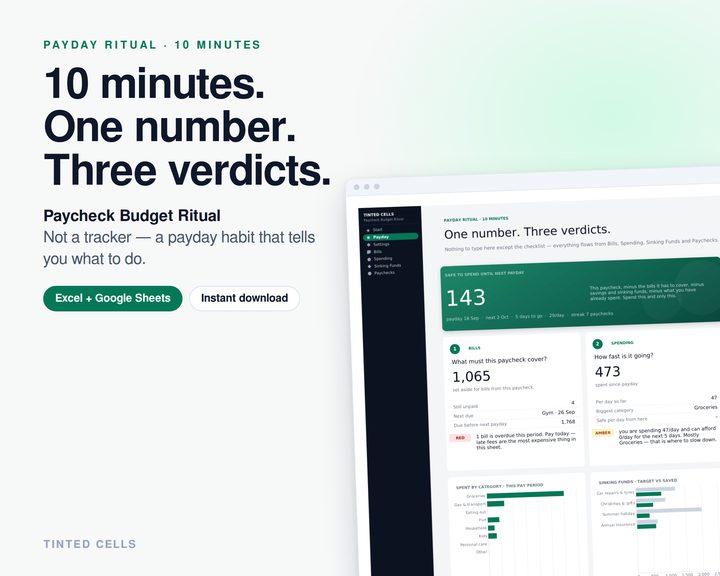
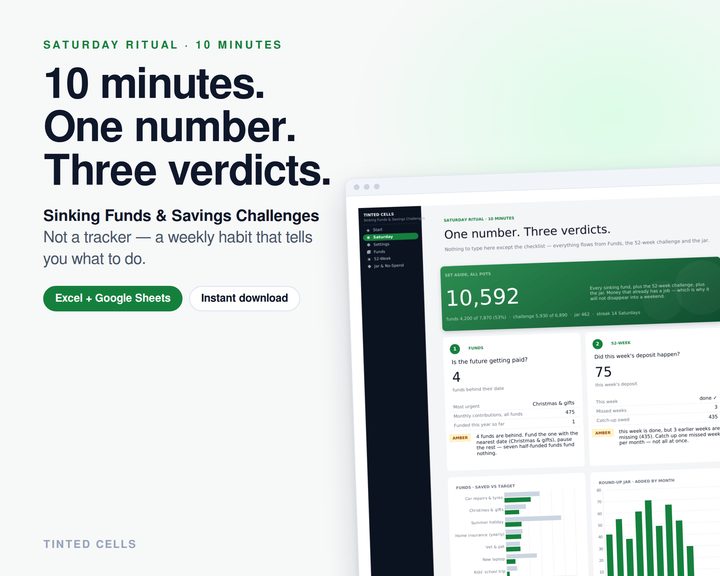
If you would rather not build it from scratch, the Household Money Ritual is this exact structure in Excel and Google Sheets: a Sunday page with the “left to spend” number and three verdicts (budget, bills, goals), an expense log, a bill calendar with paid status, savings goals with deadlines and a twelve-month overview. There is also a free Lite version to try the weekly ritual first.
Whichever way you go, the rule is the same: one number, one weekly check, and as few categories as you can live with. That is the budget you will still be opening in March.