Sinking funds explained: how to stop 'surprise' expenses that aren't actually surprises
Learn what a sinking fund is, the formula (amount ÷ months left), and how a household setting aside $310/month ends surprise expense months for good.
Car insurance renews every six months and it is never a surprise — it happens on the same schedule every year. Neither is the holiday season, or the fact that tires wear out, or that a car registration fee comes due every January. Yet these expenses get treated as emergencies because most household budgets have no place to put money for them ahead of time, so when the bill arrives it either goes on a credit card or drains the emergency fund that was supposed to be for something unplanned. A sinking fund fixes this by turning a predictable future expense into a small, boring monthly transfer instead of a once-a-year crisis.
What a sinking fund actually is
A sinking fund is money set aside in advance, in small regular amounts, for a specific expense you know is coming — even though you don’t know the exact date, or the expense only happens once or twice a year. It is not an emergency fund, and the distinction matters: an emergency fund covers the unplanned (a job loss, a medical bill, a broken appliance) and should stay untouched and general-purpose, while a sinking fund covers the planned-but-irregular (things you know will happen, just not this month) and is meant to be spent down to zero on schedule, then rebuilt.
The formula
The math behind every sinking fund is one division:
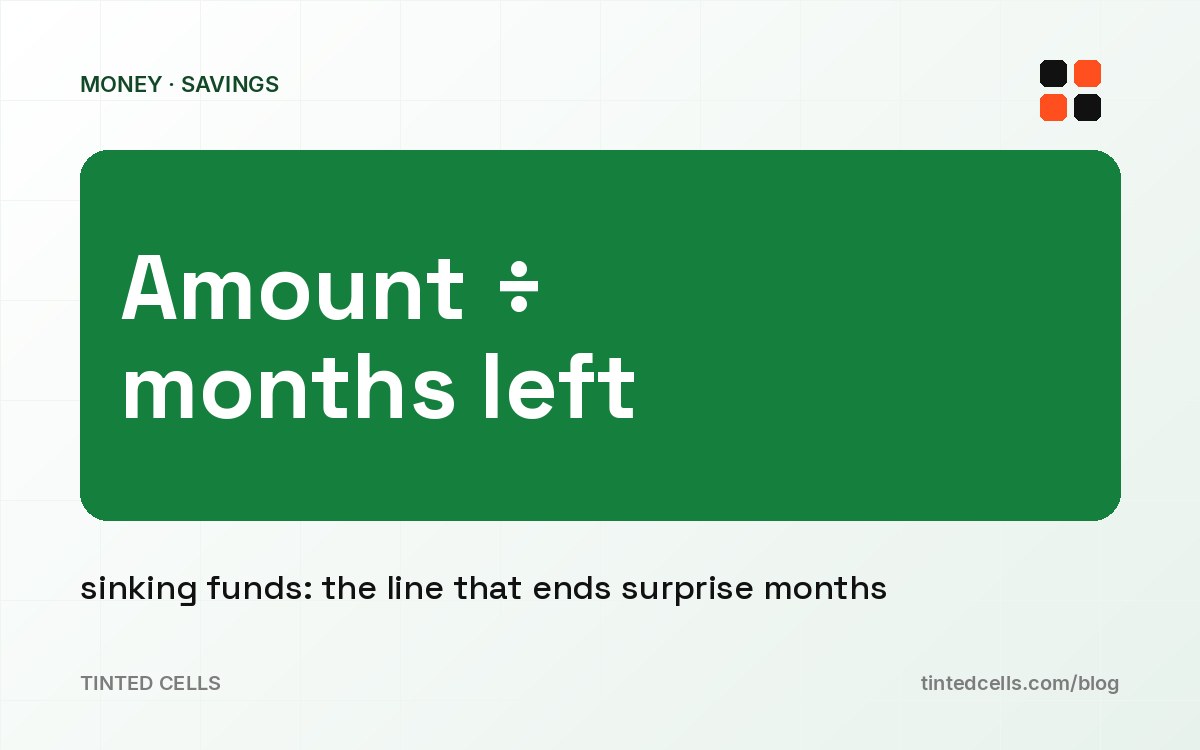
Monthly set-aside = total amount needed ÷ number of months until it’s due
If car insurance renews in 6 months at $720, the monthly set-aside is $720 ÷ 6 = $120/month. When the bill arrives, the money is already there, the transfer already made twelve times in smaller pieces instead of once in a painful one. If the renewal date has already passed and a new six-month cycle just started, the fund resets to $720 ÷ 6 again — a sinking fund is not a one-time savings goal, it’s a recurring line that renews every time its expense recurs.
Eight typical pots
Most households can identify their sinking fund needs from a short, familiar list. Car insurance, paid semi-annually or annually in states where installment plans carry a fee for paying monthly. Car maintenance and tires, since a set of tires running $600–$900 every three to five years is entirely predictable in total even if the exact month isn’t. Holidays and gifts, the single most common budget-buster in December for households that didn’t set anything aside starting in January. Annual subscriptions and memberships — software, streaming bundles paid yearly, a gym or club membership — that are cheaper paid annually but land as one large charge. Home maintenance, from a $400 furnace tune-up to a $2,000 roof repair that isn’t urgent enough to be an emergency but is certain enough to plan for. Medical and dental, covering predictable annual costs like an eye exam, a dental cleaning copay, or a known prescription renewal. Car registration and license renewal, a small but reliably annual fee. And travel, whether a planned family trip or a recurring visit home, since the total cost is knowable well before the trip is booked.
Worked example: a household setting aside $310/month
A household reviews its coming year and lists five sinking funds. Car insurance: $720 due in 6 months, so $120/month. Holiday gifts: $900 needed by December, and it’s currently April (8 months out), so $900 ÷ 8 = $112.50/month. Car maintenance and tires: an estimated $900 over the next 24 months, so $900 ÷ 24 = $37.50/month. Annual software and streaming bundle: $180 due in 10 months, so $18/month. Home maintenance reserve: $850 targeted over 12 months, so $850 ÷ 12 ≈ $70.83/month.
Total monthly set-aside: $120 + $112.50 + $37.50 + $18 + $70.83 = $358.83, which the household rounds to a clean $360/month split across five separate savings buckets (a single savings account with sub-labels, or five small accounts, works equally well — what matters is that the money is earmarked, not just sitting in checking waiting to be spent on something else). If the household instead sets a flat $310/month across the same five pots proportionally, the car insurance and holiday funds — the two nearest-term and largest-dollar pots — are the ones to prioritize first, since falling short on a fund with 8–12 months of runway is far less disruptive than falling short on one due in a few weeks.
Why this is different from an emergency fund
An emergency fund answers “what happens if something goes wrong that I didn’t see coming” and its target size is usually expressed as a number of months of expenses (commonly 3–6). A sinking fund answers “what happens when something I already know is coming, arrives” and its target size is always the specific known cost of that specific known thing. Mixing them is the most common sinking-fund mistake: a household that keeps one general savings account for both ends up unsure, every time a bill or a real emergency hits, how much of the balance is actually available versus already earmarked for December’s gifts or June’s insurance renewal.
How it removes the “surprise” month
The entire value of a sinking fund is psychological as much as mathematical: once car insurance, tires, and holidays each have their own funded line, the months they actually land in stop being budget emergencies and become ordinary transfers from a bucket that was already full. Nothing about the expense changed — insurance still renews every six months — but the household’s relationship to it did, because the math was done in April instead of in a panic in October.
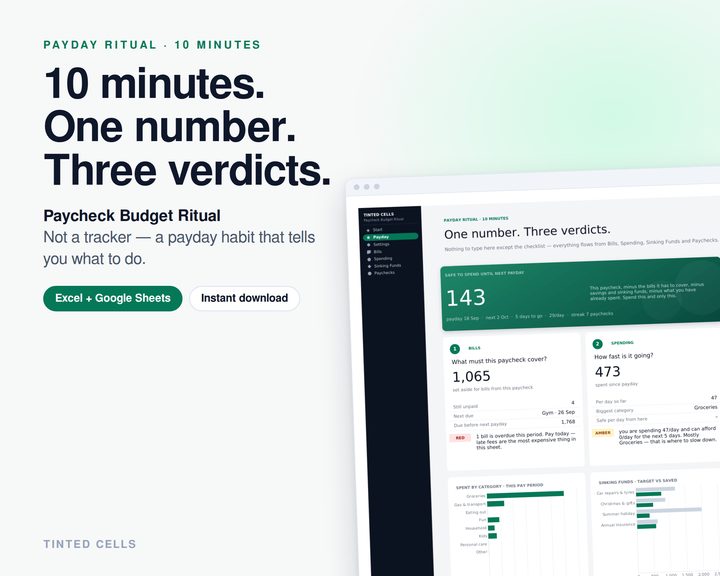
The Sinking Funds & Savings Challenges workbook automates exactly this: list your pots with their target amounts and due dates, and it calculates the monthly set-aside for each one automatically, tracks contributions against target as you go, and flags any pot falling behind schedule before its due date arrives. The formula-level takeaway to use today without any spreadsheet: take the total amount you’ll need, divide by the number of months until it’s due, and transfer that amount every month into a bucket you don’t touch for anything else — repeat for every predictable expense, and “surprise” months stop happening.