Your freelance hourly rate isn't what you quoted: the effective rate method
Calculate your real freelance hourly rate from ALL hours worked, not just billable ones, with a worked $80/h quoted to $41/h effective example.
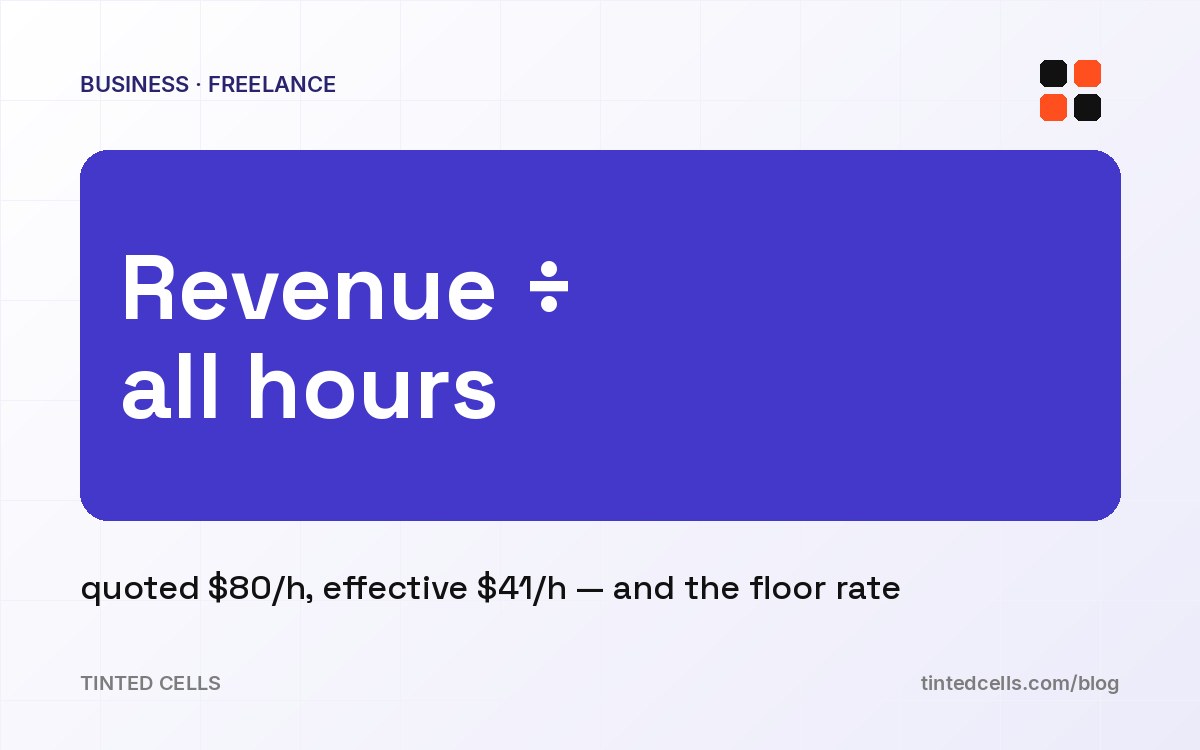
A freelancer who quotes $80/hour and works 30 billable hours in a week assumes they earned $2,400 that week. Often they didn’t — not because the client underpaid, but because the 30 billable hours sat inside a week that also included unpaid briefing calls, two rounds of revisions that weren’t scoped into the original estimate, an hour chasing down a late invoice, and the general admin of running a one-person business. The quoted rate is what you charge per hour of work you can bill. The effective rate is what you actually earned per hour of work you actually did, and the two numbers are often nowhere close.
Effective rate = revenue ÷ all hours
The formula is simple once you accept the definition of “all hours”:
Effective rate = total revenue for the period ÷ total hours worked (billable and unbillable)
Total hours worked includes the client call to scope the project, the unpaid revision round, the time spent writing the proposal that didn’t get accepted, the hour spent invoicing and following up on a payment that’s 20 days late, and any admin — bookkeeping, tool setup, email — that keeps the business running but isn’t billed to anyone.
Worked example: $80/h quoted becomes $41/h effective
A freelance designer quotes $80/hour and logs 30 billable hours in a week, so the invoice reads $2,400. Now add up the rest of the week. A discovery call and project briefing for a new client: 3 hours, unbilled. One round of revisions the client considered “included” but wasn’t scoped into the original quote: 4 hours, unbilled. Admin — invoicing, bookkeeping, replying to emails, updating the portfolio: 5 hours, unbilled. Chasing a 20-day-late invoice from a previous project: 1 hour, unbilled. Proposal writing for two prospects, one of whom didn’t sign: 3 hours, unbilled.
Total hours worked: 30 + 3 + 4 + 5 + 1 + 3 = 46 hours. Effective rate: $2,400 ÷ 46 = $52.17/hour — already a big drop from the $80 quoted rate, and that’s before accounting for the weeks with no income at all, like time off or a slow month between contracts. Extend the same ratio across a typical month where one week in four has little or no billable work (vacation, illness, a gap between projects), and the effective rate for that month drops further, often into the $40s for a freelancer whose quoted rate is $80. That’s the origin of the “$80/h quoted → $41/h effective” pattern: it isn’t one bad week, it’s the combination of unbilled hours plus unbilled weeks compounding across a full month.
Computing a floor rate backward from target income
Rather than guessing at a quoted rate and hoping the effective rate works out, it’s more reliable to solve backward from the income you actually need. Three inputs are required: target annual income, billable share (the fraction of total working hours that end up billable — commonly 50–70% for freelancers once admin, sales, and unbilled work are counted), and overhead (business costs — software, insurance, a portion of self-employment tax, equipment — that come out before the target income is “take-home”).
Floor rate = (target income + annual overhead) ÷ (working hours per year × billable share)
Take a freelancer who wants $70,000 in take-home income, has $8,000 in annual overhead, works a 40-hour week for 48 weeks a year (1,920 hours), and realistically bills 60% of that time (1,152 billable hours, with the rest lost to briefing, revisions, admin, and marketing). Floor rate = ($70,000 + $8,000) ÷ 1,152 = $78,000 ÷ 1,152 ≈ $67.71/hour. That’s the minimum quoted rate needed to hit the income target given how much of the week is actually billable — not the rate a freelancer picks by checking what competitors charge.
Notice the billable share is the lever that moves the most. At 70% billable (1,344 hours), the same target drops the floor rate to $78,000 ÷ 1,344 ≈ $58.04/hour. Improving billable share — tighter scoping to cut unpaid revisions, templated proposals, batched admin — often does more for take-home income than raising the quoted rate, because it changes the denominator in a formula that raising the rate alone doesn’t touch.
What to log every Friday
The gap between quoted and effective rate only becomes visible with a weekly log, and it needs four things, tracked honestly: billable hours per client, unbillable hours by category (briefing, revisions, admin, proposals, invoice-chasing), total revenue invoiced that week, and total hours worked across everything. Five minutes on a Friday, reviewed monthly, turns “I think I’m doing fine” into an actual number — and it’s usually the unbillable-hours category, not the quoted rate, that explains a disappointing month.
The Freelancer Ritual automates this tracking: log hours by category each week and it calculates your effective rate automatically, flags when it drops below your floor rate, and shows which unbillable category is eating the most time so you know whether to fix scoping, raise your quoted rate, or both. The formula-level takeaway to use without buying anything: your real hourly rate is total revenue divided by every hour you worked, not just the ones you billed — and your floor rate is (target income plus overhead) divided by (working hours times billable share).